
Side Hustle Tax: How the ATO Tracks Your Online Sales in 2026

Updated: May 29
Quick Answer: The 2026 "Digital Eye"
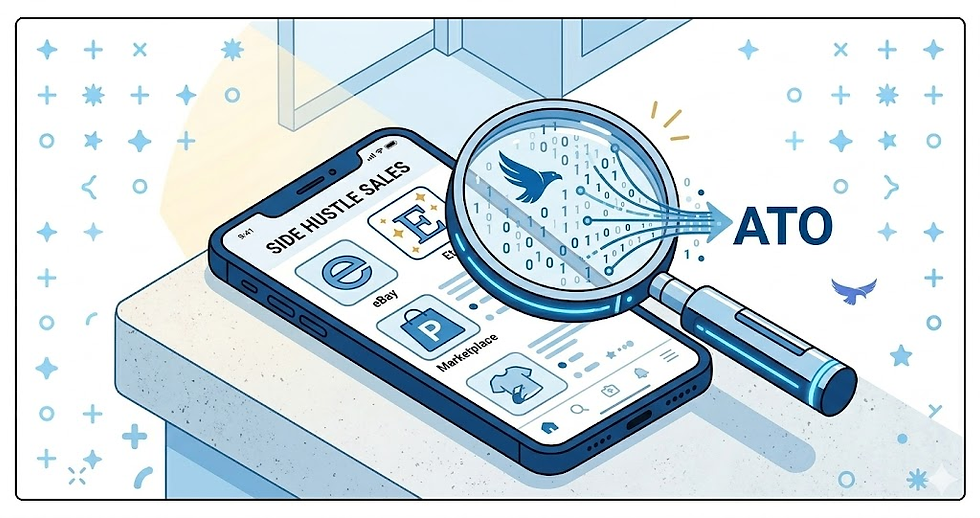
In 2026, the Australian Taxation Office (ATO) uses a sophisticated web of automated systems to track side hustle income. If you sell goods or services online, the ATO likely already knows your earnings through three primary channels:
SERR (Sharing Economy Reporting Regime): Digital platforms (eBay, Etsy, Uber, Airbnb, etc.) must report your identity and transaction totals to the ATO twice a year.
Bank & Payment Data: The ATO receives data from Australian banks, PayPal, and Square, matching large or frequent deposits to your tax return.
AI Data Matching: Advanced algorithms scan for "business-like" patterns—even for cash sales advertised on Facebook Marketplace or Gumtree.
The Verdict: There is no "tax-free" threshold for side hustles. If it’s a business, every dollar counts. Tax Falcon helps you lodge these complex sales in 10 minutes with full audit protection.
Introduction: The End of the "Hidden" Side Hustle
The year 2026 marks a turning point in Australian tax history. The "side hustle"—once a casual way to earn a few extra bucks under the radar—has become a multi-billion dollar pillar of the economy. Whether you are flipping vintage clothes on eBay, selling handmade ceramics on Etsy, or offering freelance services on the side, you are part of a digital ecosystem that the ATO is now monitoring with surgical precision.
For years, many Aussies believed that if their sales were "small" or "in cash," the taxman wouldn't notice. However, the implementation of the Sharing Economy Reporting Regime (SERR) has effectively turned the lights on. In 2026, the question is no longer "Will they find out?" but rather "How do I ensure I’ve claimed enough deductions to protect my profit?"
At Tax Falcon, we’ve built our 2026 platform to bridge the gap between the ATO’s data and your actual bank balance. This guide explains the mechanics of how the ATO tracks your online sales, the difference between a hobby and a business, and how you can stay compliant without the stress.
1. What is SERR? (The 2026 Reporting Powerhouse)
The Sharing Economy Reporting Regime (SERR) is the ATO’s most potent tool for tracking online income. It requires "Electronic Distribution Platforms" (EDPs) to collect and report information about their sellers.
Who is Reporting Your Income?
By July 2026, almost every major digital platform operating in Australia is a "mandatory reporter." This includes:
Marketplaces: eBay, Etsy, Amazon Australia, MyDeal.
Service Platforms: Airtasker, Hipages, Mad Paws, Fiverr.
Accommodation & Transport: Airbnb, Stayz, Uber, DiDi.
What Data Does the ATO Receive?
Twice a year (31 January and 31 July), these platforms send an XML data file to the ATO containing:
Your Full Name, DOB, and Address.
Your ABN or TFN (if provided).
Your Bank Account Details used for payouts.
The Total Gross Value of your transactions (before fees).
The Falcon Insight: This data is automatically matched to your Tax File Number. When you open your Tax Falcon return, you may see a "pre-fill" notification showing exactly how much eBay or Etsy has reported. If your numbers don't match theirs, the AI triggers an immediate "Please Explain" letter.
2. The "Hobby vs. Business" Debate in 2026
This is the #1 question we get at Tax Falcon: "I only sold a few things, do I really have to pay tax?" The ATO uses a "Business-Like Manner" test to decide.
You are likely a HOBBY if:
You are selling personal items you no longer need (e.g., your old couch or a bag of baby clothes).
You sell the items for less than you originally paid for them.
Your activity is irregular and you have no intent to make a profit.
Tax Status: You generally don't need to report this income.
You are likely a BUSINESS if:
You buy or make items specifically to sell them for a profit.
You have a repeat pattern of sales (e.g., selling 5 items every week).
You use a business name, have an ABN, or advertise your "shop."
You keep records in a "business-like" way (even if it’s just an Excel sheet).
Tax Status: You must report every dollar of income and can claim related deductions.
The 2026 Reality Check: The ATO’s AI is now very good at spotting "Resellers." If you are buying bulk stock from Alibaba or picking up items from op-shops to flip for a profit, the ATO views you as a business from the very first sale.
3. How the ATO Tracks "Cash" Sales (Facebook & Marketplace)
"But I only sell for cash on Facebook Marketplace!" is a common refrain. In 2026, even "off-platform" sales are becoming visible.
The Banking Web
The ATO has data-sharing agreements with all major Australian banks. Their software scans for "high-frequency, low-value" deposits into personal accounts. If your "hobby" is resulting in $500 worth of "PayID" or cash deposits every weekend, the bank's internal AML (Anti-Money Laundering) and tax flags will eventually alert the ATO.
Third-Party Payment Processors
Payments made via PayPal, Square, or Stripe are 100% transparent. These companies provide annual reports to the ATO. If you use a "Business Account" with PayPal to collect payments for your side hustle, the ATO is already looking for that income in your return.
4. The 2026 "Side Hustle Tax Bill" Phenomenon
As of early 2026, we are seeing a surge in what the media calls "The Side Hustle Shock." Thousands of Australians who ignored their online sales in 2024 and 2025 are now receiving amended assessments from the ATO—often with penalties of up to 75% for "reckless" or "intentional" disregard of tax law.
Why now?
The SERR data from the last two years has finally been fully integrated into the ATO's AI models. The system is now retroactively "cleaning up" old returns.
The Lesson: It is significantly cheaper to declare your side hustle income correctly today than it is to pay the back-tax, interest, and penalties three years from now. To understand exactly what patterns the ATO's AI is hunting for, read our full guide on ATO audit targets .
5. Legitimate Deductions: Protecting Your Profit
The good news is that if the ATO views you as a business, they also allow you to claim business expenses. This is where Tax Falcon's expert review saves you money. Understanding the top 10 missed tax deductions can also help side hustlers maximise legitimate car-related deductions they may otherwise overlook.
Cost of Goods Sold (COGS): What you paid for the items you sold.
Platform Fees: The 10%–15% that eBay or Etsy takes is a 100% deduction.
Shipping & Packaging: Every satchel, roll of bubble wrap, and Australia Post fee.
Home Office: If you use a spare room to store stock or pack orders, you can claim the 70c/hour WFH rate.
Marketing: Boosting your posts on Facebook or paying for "Promoted Listings" on eBay.
The Tax Falcon "Side Hustle" Success Roadmap
We’ve designed our platform to make side-hustle compliance as fast as your sales.
Sync Your Sales: We pull your pre-fill data from the ATO (which includes the SERR reports from eBay, etc.).
Categorise in 10 Mins: Our simple questions help you separate your "Hobby" sales (like your old bike) from your "Business" sales (the 50 shirts you flipped).
Maximise Deductions: We prompt you for "forgotten" costs like data usage, home office power, and shipping supplies.
Expert "Safety-Check": A human professional reviews your "Hobby vs Business" classification to ensure it stands up to an ATO audit.
FAQ: Side Hustle Tax 2026
Is there a "tax-free" amount for side hustles?
No. There is no "$600 limit" or "$1,000 threshold" in Australia like there is in some other countries. If you are operating as a business, your first $1 of profit is taxable. However, it only results in a "tax bill" if your total income (including your main job) is over the $18,200 tax-free threshold.
Do I need an ABN for a side hustle?
If you are carrying on a business, you should have an ABN. It’s free to get, makes you look professional, and is required if you want to register for GST or open a business bank account.
What if I sell my items at a loss?
If you consistently sell at a loss (like a hobbyist clearing out a garage), you don't pay tax. If you are a business and you make a loss, you can often use that loss to reduce the tax you pay on your main salary—a huge benefit that many people miss!
How does the ATO know if I'm selling on Marketplace?
Through bank data matching. Frequent small deposits labeled "Marketplace," "Sale," or "PayID" trigger patterns that the ATO’s AI identifies as "Unreported Business Income."
Conclusion: Transparency is Your Friend
In 2026, trying to hide an online side hustle is a losing game. The "Digital Taxman" is too fast and too well-connected. However, being transparent doesn't mean you have to lose all your profit to the ATO.
By embracing your side hustle as a legitimate business, you unlock a world of deductions that can significantly lower your overall tax bill. With Tax Falcon, you get the best of both worlds: a 10-minute lodgement that handles the complex data matching for you, and the expert review you need to ensure you're only paying what you legally owe.
Don't wait for a "Please Explain" letter. Lodge your 2026 side hustle return with Tax Falcon today and keep your profit protected!


