
Claiming Car Expenses in 2026: Cents per KM vs. Logbook

Updated: May 29
Quick Answer: Which Method Should You Use?
In 2026, the ATO provides two main ways to claim the cost of using your own car for work. The "best" method depends on how much you drive and what records you’ve kept:
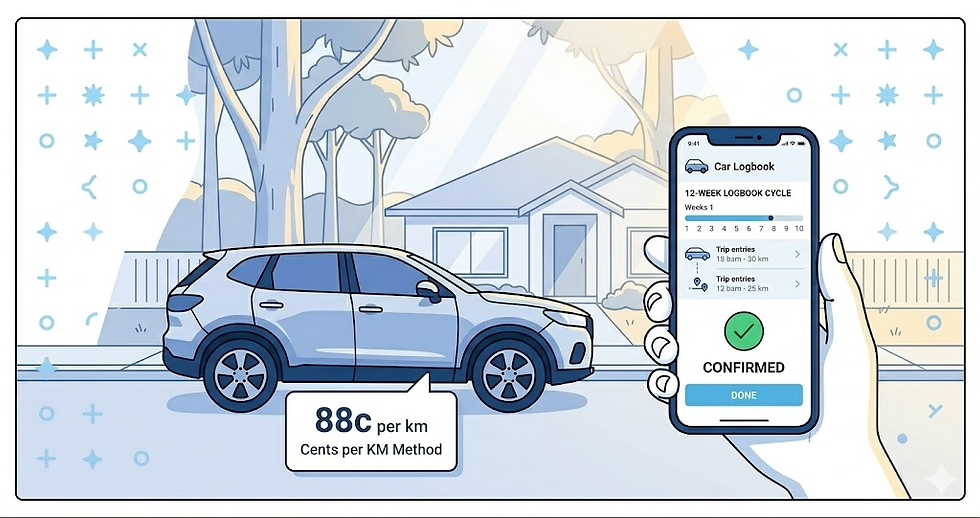
Cents per Kilometre (88c per km): Best for those who drive less than 5,000km for work. You don't need receipts, but you must be able to show how you calculated your distance. Max claim: $4,400 per car.
Logbook Method: Best for high-mileage drivers or those with expensive cars. You claim the actual percentage of all running costs (fuel, insurance, repairs, depreciation). You must keep a 12-week logbook.
The "Falcon" Rule: If you drive more than 100km a week for work, the Logbook method usually results in a significantly larger refund.
Introduction: Putting Your Car to Work (Tax-Wise)
For many Australians, their car is their most significant work tool. Whether you’re a sales rep visiting clients, a nurse moving between hospitals, or a tradie picking up supplies, the cost of fuel, insurance, and wear-and-tear adds up quickly. This is why understanding tax deductions for nurses can make a significant difference during tax time.
However, "claiming your car" is one of the areas where the ATO sees the most errors. Many people mistakenly believe they can claim their daily commute from home to work, or they "guess" their kilometres at the end of the year—a move that the ATO’s new AI data-matching system flags instantly in 2026. If you drive for a platform like Uber or Menulog, the rules have additional layers covered in our gig economy tax guide.
At Tax Falcon, we’ve simplified the car expense minefield. Our 10-minute online flow helps you compare both methods side-by-side to ensure you aren't leaving hundreds of dollars at the petrol pump. This guide breaks down the 2026 rules, the new 88c rate, and the "logbook vs. cents per km" debate so you can drive away with a bigger refund.
1. The Cents per Kilometre Method (The "Easy" Way)
The Cents per Kilometre method is the most popular choice for everyday Aussies because it requires the least amount of paperwork.
The 2025–26 Rate: 88 Cents
For the financial year ending 30 June 2026, the ATO has set the rate at 88 cents per kilometre. This single rate is designed to cover all your running costs:
Fuel and oil
Maintenance and repairs
Registration and insurance
Depreciation (the decline in value of your car)
The 5,000km Limit
You can claim a maximum of 5,000 work-related kilometres per vehicle per year using this method.
Calculation: 5,000 km x $0.88 = $4,400 deduction.
If you drive 7,000km, you can still only claim the first 5,000km under this method. If you want to claim more, you must use the Logbook method.
Record-Keeping Requirements
While you don't need receipts for fuel or rego, you cannot just make up a number. The ATO requires you to be able to show how you reached your total when claiming car expenses in 2026.
Acceptable Evidence: A diary of work trips, copies of calendar entries, or a simple spreadsheet.
The AI Check: In 2026, the ATO cross-checks your odometer readings from your last pink slip/service against your claim. car claims are now one of the most closely monitored areas on the ATO audit targets If the math doesn't add up, your refund will be paused.
2. The Logbook Method (The "Pro" Way)
If you drive your car extensively for work, the Logbook Method is almost always more profitable, even if it takes a bit more effort.
How it Works
Instead of a flat rate, you claim the actual business use percentage of every dollar you spend on your car.
The 12-Week Log: You must keep a logbook for 12 continuous weeks. This logbook is then valid for 5 years, provided your driving habits don't change significantly.
Calculate the %: If your logbook shows you drove 4,000km total and 3,000km was for work, your business use is 75%.
Apply the %: You add up every car expense for the year (fuel, insurance, rego, interest on the loan, and depreciation) and claim 75% of the total.
2026 Logbook Requirements
A valid logbook in 2026 must contain:
Date of the trip (Start and End).
Odometer readings at the start and end of the trip.
Total kilometres travelled.
The Reason for the trip (be specific—"Client Meeting" is better than "Work").
Falcon Tip: Use a digital logbook app! The ATO fully accepts digital logs, and they are much harder to lose than a paper diary tucked in the glove box.
3. Cents per KM vs. Logbook: The 2026 Math
Let’s look at a real-world example for the 2025–26 year.
Meet Dave: Dave drives a $40,000 SUV and travels 6,000km for work.
Method 1 (Cents per KM): He claims 5,000km (the max) x 88c = $4,400 deduction.
Method 2 (Logbook): Dave’s total car costs for the year (fuel, rego, insurance, and $5,000 in depreciation) come to $12,000. His logbook shows 60% business use.
Calculation: $12,000 x 60% = $7,200 deduction.
By choosing the Logbook method, Dave gets an extra $2,800 in deductions, which could mean an extra $900+ in his actual refund.
Feature | Cents per KM (88c) | Logbook Method |
Max Kilometres | 5,000km | Unlimited |
Receipts Needed? | No | Yes (all expenses) |
Logbook Needed? | No (Diary only) | Yes (12 continuous weeks) |
Depreciation? | Included in 88c | Claimed separately |
Best for... | Casual/Low work travel | High mileage / Expensive cars |
4. The "Commute" Myth: What You Can and Can't Claim
This is where 90% of ATO car audits happen.
Generally NOT Deductible:
The Daily Commute: Driving from home to your regular office is "private travel," even if you do it outside of normal hours or live a long way away.
Minor Tasks on the Way: Stopping to pick up the mail or a coffee for the office on your way to work does not make the whole trip deductible.
Generally Deductible:
Alternative Workplaces: Driving from your office to a client site or another hospital.
Bulky Tools: If you must transport heavy/bulky tools (like a massage table or a full toolkit) and there is no secure storage at work, the commute may be deductible.
Itinerant Work: If you have no "home base" and travel to different sites daily (like some agency nurses or consultants).
5. 2026 Update: Electric Vehicles (EVs) and Luxury Limits
If you’ve upgraded to a Tesla or another EV in 2026, there are specific rules you need to know.
The EV Home Charging Rate
The ATO now provides a "Home Charging Rate" of 4.2 cents per kilometre for EVs. If you use the Logbook method, you can use this rate to estimate your electricity costs instead of trying to separate your car charging from your home’s toaster and TV.
The 2025–26 Car Limit
If you bought an expensive car for work this year, your depreciation is capped. The Car Limit for 2025–26 is $69,674.
Even if your new car cost $100,000, you can only calculate your depreciation based on that $69,674 limit. (Note: The Luxury Car Tax thresholds are higher—$91,387 for fuel-efficient vehicles—but the depreciation limit remains lower).
6. How Tax Falcon Maximises Your Car Claim
We’ve built our 10-minute flow to take the "math stress" out of your car expenses.
Dual-Method Calculation: We ask you for your kilometres and your expenses, then we instantly show you which method gives you the bigger refund.
Logbook Validation: Our human experts check your 12-week logbook for "common errors" that the ATO AI looks for (like missing odometer readings).
Depreciation Engine: You don't need to know the difference between "Straight Line" and "Diminishing Value" depreciation. You just tell us the car’s price and date of purchase, and we do the rest.
FAQ: Claiming Car Expenses 2026
Can I claim car expense if I use my partner's car?
Generally, you can only use these methods if you own or lease the car. If the car is owned by your spouse, you can only claim the actual expenses (fuel/oil) for work trips, rather than using the 88c per km rate.
What if I have a novated lease or salary sacrifice?
If your car is part of a salary packaging arrangement, you usually cannot claim car expenses in your tax return. This is because your employer is already paying for the car out of your pre-tax income. Check with Tax Falcon if you're unsure!
Do I need to record every single trip for the 88c method?
You don't need a formal logbook, but you must be able to show a "reasonable basis." A diary showing your typical weekly routine or a record for a "sample month" is usually enough to satisfy the ATO.
Can I claim my car insurance on tax?
If you use the Logbook Method, yes—you claim the business-use percentage of your premium. If you use the Cents per KM method, the 88c rate already includes the cost of insurance.
Conclusion: Don't Leave Your Car Expenses Behind
Whether you drive 500km or 50,000km for work, your car is a significant expense that the ATO is willing to help you cover. In 2026, with fuel and insurance prices at record highs, every kilometre counts.
By understanding the 88-cent rate and knowing when to switch to a logbook, you can turn your "daily driver" into a "tax winner."
Not sure which method to pick? Lodge your 2026 return with Tax Falcon and let our smart-comparison engine find the biggest refund for you!


